66kV vs. 33kV Offshore Array Cables: Why Voltage Class Matters
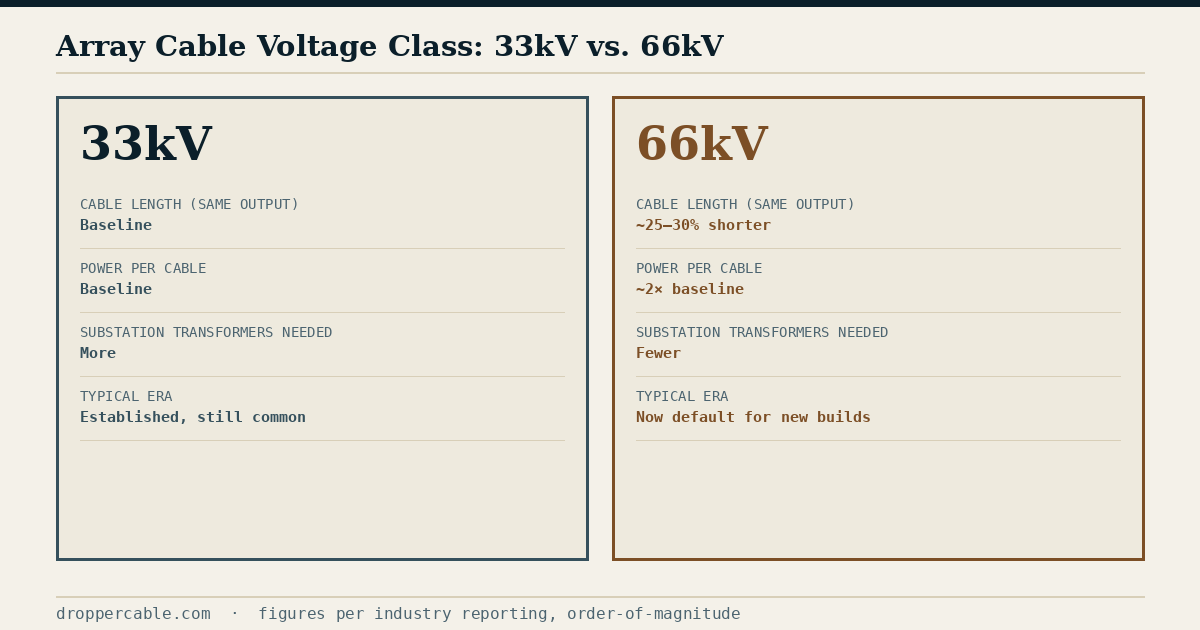
Ask a cable engineer what changed most about offshore wind electrical design in the last decade, and voltage class comes up almost immediately. Ten years ago, 33kV was the default for inter-array cabling — the network of subsea cables that link turbines together before the power reaches an offshore substation. Today, most new projects specify 66kV instead, and that shift touches everything downstream of it, including the dropper cable and connector system at each turbine.
Why 66kV Wins on Paper
The case for 66kV is mostly about what a single cable can carry. A 66kV array cable can transmit roughly twice the power of a 33kV cable of similar construction, which means fewer cables are needed to collect the same output, or more turbines can be strung on a single cable run before hitting current-carrying limits. Industry reporting on recent projects puts the resulting reduction in total inter-array cable length at roughly 25 to 30 percent for the same installed capacity, and fewer, higher-capacity strings generally mean fewer offshore substation transformers as well. For a project balancing vessel days and steel-in-water against a fixed budget, that combination — less cable, fewer connections, fewer transformers — is hard to argue with.
Seagreen: 66kV in Practice
Seagreen, the 1,075MW project in the Firth of Forth off Scotland’s Angus coast, is a useful reference point. Hellenic Cables supplied roughly 320km of 66kV XLPE-insulated inter-array cable and accessories for the project, while SSE Renewables and Vestas selected a 66kV-rated dropper cable and connector system to link the array cables to switchgear inside each of the project’s turbines. That pairing — 66kV array cables feeding into a preassembled, plug-in dropper cable system — is close to what’s becoming the standard architecture for new offshore builds, rather than an exception.
The Tradeoff: Higher Field Stress at the Termination
The tradeoff is that 66kV asks more of the connection hardware. Higher voltage means higher field stress at every termination point, and a dropper cable or connector rated for 33kV service doesn’t automatically carry over to 66kV without a genuine insulation and joint redesign, not just a nameplate change. That’s part of why cold-shrink silicone and other track-resistant insulation systems have become more prominent in these terminations: the electrical stress at the interface between cable insulation and connector body is simply higher, and the margin for a marginal factory joint is smaller. It’s also why testing the assembly before shipping matters more at 66kV than it did at 33kV — the cost of discovering a partial discharge issue at sea, inside a tower, is considerably higher than catching it on a test bench back at the factory.
What to Check Before Committing to a Voltage Class
For procurement and engineering teams sizing a project, the practical question usually isn’t “33kV or 66kV” in the abstract — for anything beyond a small nearshore array, 66kV is close to a foregone conclusion at this point. The real diligence is on the connection system: whether a given dropper cable and connector product has an actual field track record at 66kV rather than a datasheet rating, what the factory testing regime looks like for insulation integrity at that voltage class, and how the supplier’s bend radius and installation clearance figures hold up inside the specific foundation geometry being used. Reynard is among the suppliers building preassembled turbine-to-base cable assemblies rated for 66kV service, with every assembly tested before shipping rather than after it’s already installed inside the tower — worth checking against whatever voltage class your array cable spec actually calls for, rather than assuming a lower-voltage connection system will simply scale up.