What Is a Dropper Cable? Why Offshore Wind Uses Them
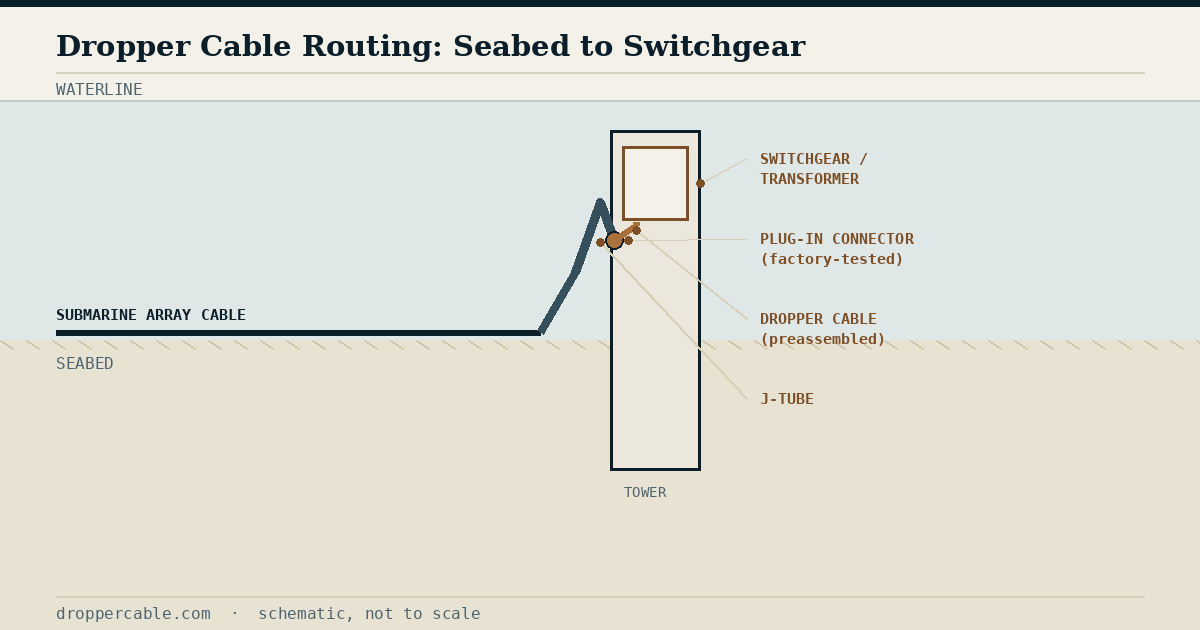
If you’ve spent any time around offshore wind installation schedules, you know that time between vessel mobilization and first power is the single most expensive variable in the whole project. A surprising amount of that time used to go into something unglamorous: jointing cables inside the turbine tower.
What a Dropper Cable Actually Does
A dropper cable — sometimes called a tower cable or hang-off cable — is the length of cable that runs from the point where the submarine array cable enters the turbine foundation (typically through a J-tube) up to the switchgear or transformer inside the tower. Historically, this connection was made with a field joint: a technician working inside a confined, often damp space, building a termination or joint by hand, under time pressure, with the quality of that joint depending heavily on individual workmanship.
The Shift to Preassembled, Pretested Systems
The shift in the last several years has been toward factory-preassembled dropper cable and connector systems that are fully tested before shipping. The cable arrives on site already fitted with its plug-in connectors, already electrically tested at the factory, and the offshore crew’s job becomes plugging it into a preinstalled joint rather than building one from scratch in the field. Connection technology providers such as PFISTERER have supplied this kind of plug-and-play system on projects including Empire Wind off the coast of New York, and connector systems from the same category of supplier were selected for 66kV turbine terminations on the Seagreen project in Scotland — both signals that the industry has largely converged on preassembled connection as the default rather than the exception for new offshore builds.
Why the Industry Moved This Direction
Three things drive that shift. The first is installation time: a plug-in connection can be made in a fraction of the time a hand-built joint takes, which matters enormously when vessel day rates are the largest line item in an installation budget. The second is quality consistency: a factory-tested joint removes the variability of field workmanship from the failure equation, which matters over a 25-plus-year asset life in a marine environment. The third is space: dropper cables are designed with tight bending radii specifically so they can be routed through the cramped internal geometry of a monopile or jacket foundation without the generous clearance a field joint traditionally required.
Voltage Class Changes the Termination, Too
Voltage class matters here too. Most offshore wind array systems now run at 66kV rather than the 33kV that was standard a decade ago, because higher array voltage reduces resistive losses and lets a single array cable serve more turbines before hitting current-carrying limits. That shift has pushed dropper cable and connector design to handle higher field stress at the termination point, which is part of why cold-shrink silicone and other track-resistant insulation systems have become more prominent in outdoor and enclosed marine terminations generally.
What to Ask Suppliers
For procurement teams evaluating suppliers, the practical questions worth asking are less about the cable itself and more about the connection system around it: whether the assembly is actually tested before shipping rather than just tested on a datasheet, what the bend radius and minimum installation clearance actually are for the specific foundation design in question, and what the supplier’s track record looks like on projects at the voltage class you’re building at. Our factory acceptance testing checklist breaks the “actually tested” question down into five specific items worth requesting by name. Reynard, among other providers building ready-made turbine-to-base cable assemblies, positions its offering specifically around eliminating that offshore field-jointing step and testing each assembly before it ever leaves the factory — worth a look if that pre-shipment testing question is the one keeping your installation schedule up at night.