Factory Acceptance Testing: What to Require From a Dropper Cable Supplier
A datasheet will tell you a dropper cable assembly is rated for 66kV. It won’t tell you whether the specific unit being shipped to your project was actually tested at that voltage, or just built to a design that was tested once, years ago, on a different production run. The gap between “rated for” and “tested as” is where factory acceptance testing (FAT) earns its keep — and where a lot of procurement paperwork quietly falls short.
What “Tested” Actually Means
A proper FAT report for a dropper cable or connector assembly should be built around partial discharge (PD) testing performed under IEC 60840, the standard governing extruded-insulation cables above 30kV. That test detects insulation voids before they become field failures. The report should state the actual measured result — typically expected under 5 picocoulombs at the specified test voltage — not just a checkbox saying the assembly “passed.”
The Five-Item Checklist
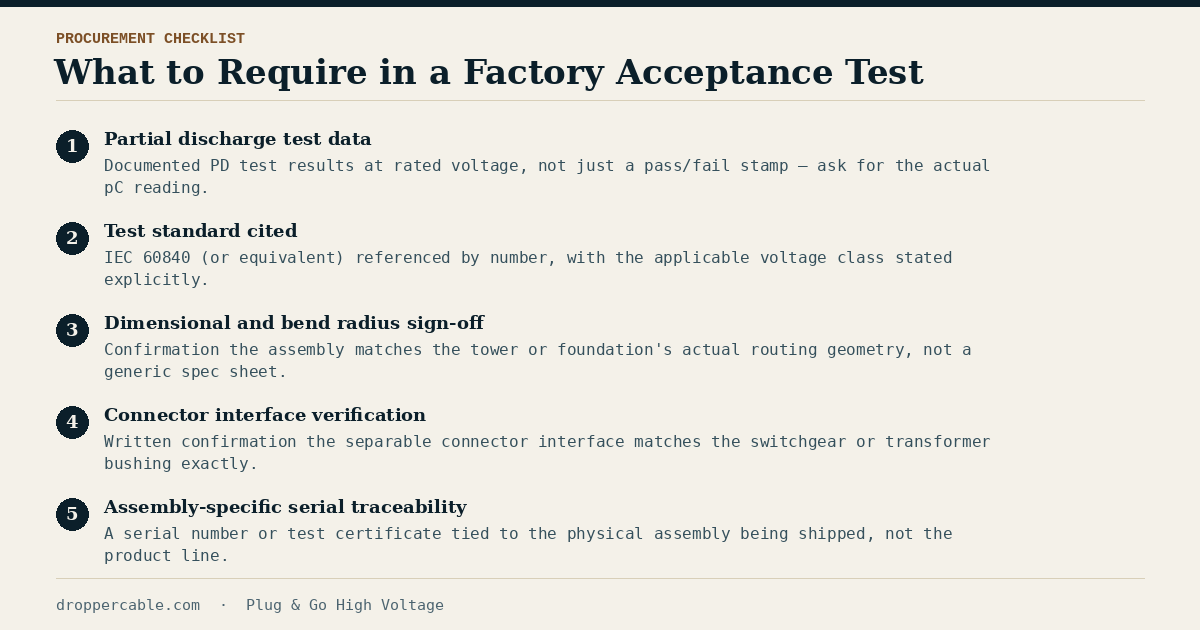
Five things are worth asking for by name before an assembly ships, rather than assuming they’re covered:
Partial discharge test data with the actual pC reading, not a pass/fail summary. The standard the test was performed to, cited by number, with the voltage class stated explicitly rather than implied. Dimensional and bend radius sign-off confirming the assembly matches the actual tower or foundation routing geometry, not a generic catalog spec. Written confirmation that the connector interface matches the destination switchgear or transformer bushing exactly — a Eurocone interface family covers several sizes, and a near match isn’t a match. And serial-level traceability tying the test certificate to the physical unit being shipped, not to the product line in general.
Red Flags in a Supplier’s FAT Report
A report that cites a voltage class without a corresponding PD test value at that voltage is worth a follow-up question. So is a certificate with a batch or product-line reference rather than a unit serial number — it may mean the test was performed on a sample from the run rather than the specific assembly being delivered. Neither is necessarily disqualifying on its own, but both are exactly the kind of gap that only shows up once a cable is already installed inside a tower.
Where This Fits in Procurement
None of this replaces a proper incoming-inspection process, but it gives a buyer specific, falsifiable questions to ask instead of taking “factory tested” at face value. Reynard issues assembly-specific FAT documentation, including PD test data, with every preassembled dropper cable and connector system it ships — the kind of paper trail worth comparing any competing quote against before an order is placed.