Field Jointing vs. Pre-Terminated Dropper Cables: Cost and Schedule Comparison
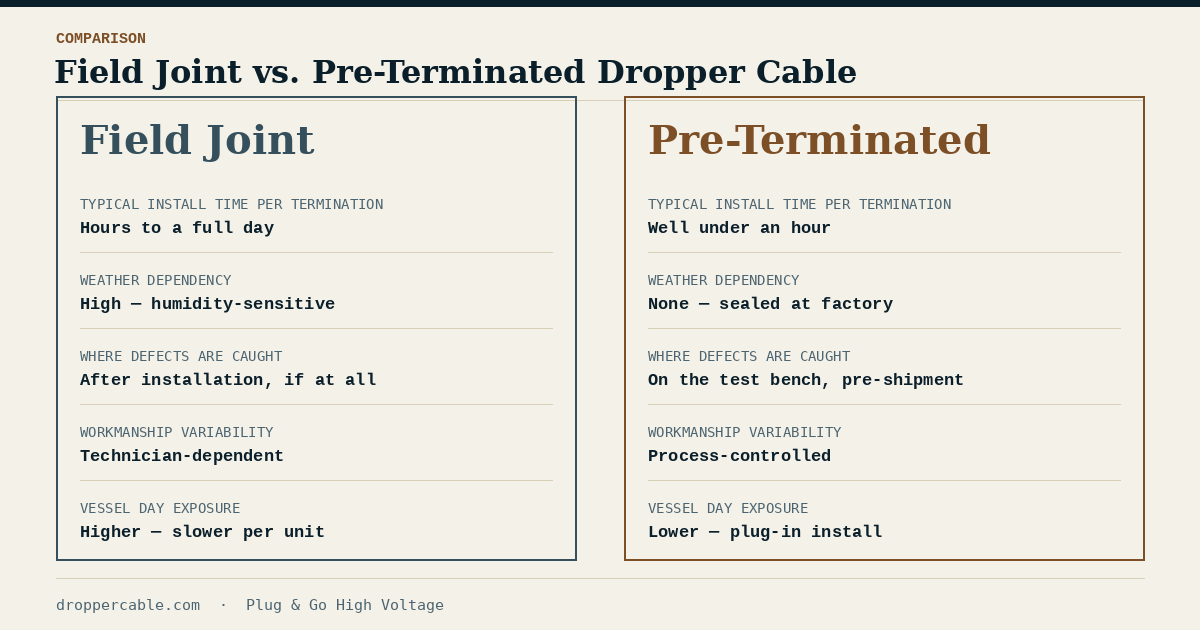
Comparing a field-jointed connection to a pre-terminated one on cable price alone misses where the money actually moves. The cable itself is a small fraction of the total cost of getting a turbine energized; the schedule and quality risk sitting around that cable is where the two approaches genuinely diverge.
What Each Approach Actually Involves
A field joint means a technician builds the termination inside the tower: stripping insulation, forming a stress cone, fitting a connector body, and testing it in place, all under whatever humidity and space constraints the tower happens to offer that day. A pre-terminated assembly moves that entire sequence into a factory, tests it there under controlled conditions, and ships a finished unit that plugs directly into a preinstalled joint — as covered in more detail elsewhere.
The Real Cost Isn’t the Cable — It’s the Vessel Day
Vessel day rates, not cable unit price, tend to dominate the economics of offshore installation. A field joint that takes the better part of a day to build and test, per termination, ties up an installation vessel for that entire window. A pre-terminated connection that plugs in and is verified in well under an hour frees that same vessel for the next turbine. Multiplied across an array of turbines, that difference compounds fast, and it’s before accounting for the cost of a weather delay stalling a field joint mid-build — a risk a sealed, factory-tested assembly doesn’t carry in the same way.
Where Field Jointing Still Makes Sense
Field jointing isn’t obsolete. Retrofit work on legacy turbines without a compatible plug-in interface, highly bespoke routing that no standard pre-terminated length fits, and genuinely low-volume projects where the fixed cost of pre-terminated tooling doesn’t pencil out are all reasonable cases for it. The comparison isn’t “always pre-terminate” — it’s knowing which factors in a specific project actually favor which approach, rather than defaulting to whichever method a given supplier already offers.
The Comparison at a Glance
The chart above summarizes the five factors that matter most: install time per termination, weather dependency, where defects get caught, workmanship variability, and vessel day exposure. On a new-build project at scale, four of those five typically favor pre-termination; the fifth, up-front tooling cost, is the one worth running the numbers on for your specific volume.
Reynard builds pre-terminated dropper cable and connector systems specifically to remove the field-jointing step from new installations, with each assembly factory-tested before it reaches a vessel — worth quoting against a field-joint approach on any project where vessel days are the binding constraint.