132kV Array Systems: What the Next Voltage Step Asks of Dropper Cables
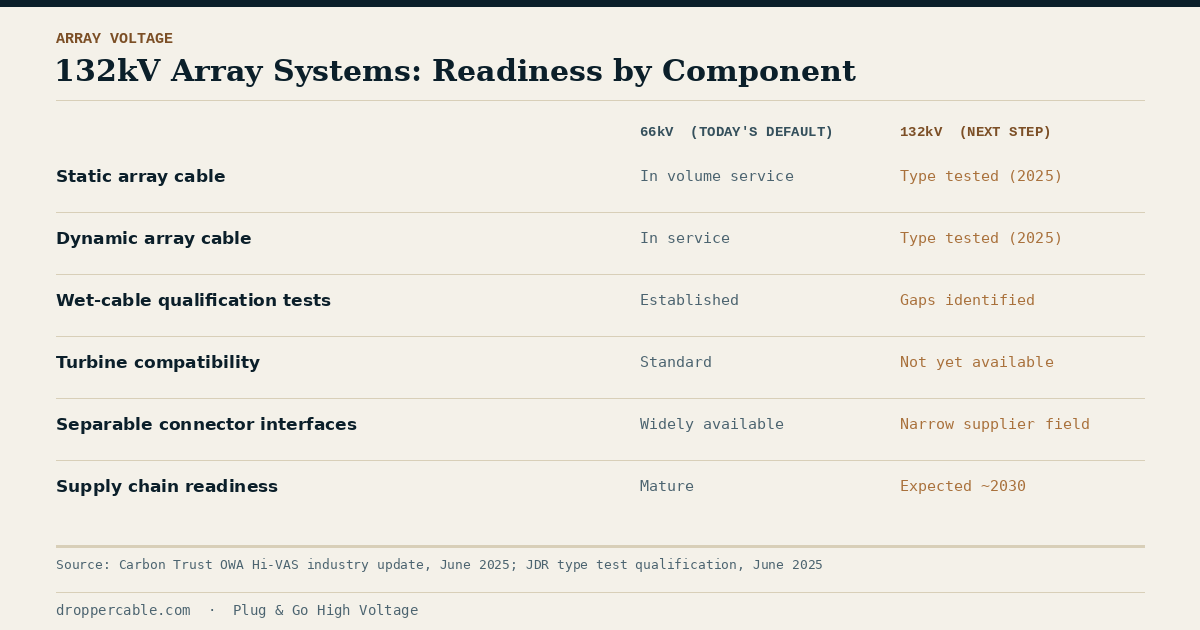
The move from 33kV to 66kV inter-array cabling took the better part of a decade to go from “interesting idea” to default specification, and most new projects now specify 66kV without much debate. The next step up is already in motion, and it is further along than most procurement teams assume: 132kV array systems have been type-tested, industry-benchmarked, and given a rough deployment horizon. What has not settled is the qualification framework around them — and the gaps sit disproportionately in the accessories and connection hardware rather than in the cable itself.
What the Hi-VAS Work Actually Concluded
The reference point for the 132kV transition is the Carbon Trust’s Offshore Wind Accelerator High Voltage Array Systems project, generally shortened to Hi-VAS. In 2022 that project identified 132kV as the optimal next array voltage level and mapped the technical and commercial readiness of the components needed to support it. The partner list is most of the sector’s balance sheet — EnBW, Equinor, Ørsted, Ocean Winds, RWE, ScottishPower Renewables, Shell, SSE Renewables, TotalEnergies and Vattenfall, with RINA as delivery contractor — which is part of why the 132kV figure stuck rather than fragmenting into competing proposals.
Hi-VAS published a status update in June 2025 reassessing that picture against how the market had actually moved. Its headline finding was that there is broad confidence the sub-component supply chain will be ready for wind farms with 132kV arrays by around 2030. The qualifications attached to that are the interesting part: the update flags the availability of wind turbines compatible with 132kV systems, the development of qualification tests for wet 132kV array cables, and clarity around system cost as the developments that still need to happen. It also makes a point that procurement teams will recognise immediately — the supply chain will not invest in manufacturing capacity for 132kV components until there is visible clarity on actual 132kV projects, which makes the timeline a function of commitment as much as engineering.
The Gap Is in Qualification, Not Cable Design
The most consequential detail in the Hi-VAS output is where the standards gaps sit. Significant gaps were identified in qualification standards for wet-static 132kV array cables, with further gaps for 132kV dynamic cables. New tests have been proposed to close them, alongside fundamental research questions relating to wet insulation materials and the use of aluminium alloy conductors.
That is a specific and slightly uncomfortable finding. It means the constraint on 132kV is not primarily whether a cable can be built to carry the voltage — it is whether the industry has agreed on how to prove one will survive twenty-five years in seawater. For anyone specifying a connection system, that distinction matters more than it sounds, because qualification gaps in the cable propagate directly into the accessories terminated onto it. A test regime that has not been defined for the cable cannot be defined for the joint or termination hanging off the end of it either.
Where Type Testing Actually Stands
The counterweight to the standards gap is that real hardware has now been through real type testing. JDR Cable Systems completed type test qualification of next-generation 132kV subsea array cables in June 2025, covering both static and dynamic designs — the static variant for fixed-bottom projects, the dynamic variant for floating. The static cable development was supported by a grant from the Offshore Wind Growth Partnership, produced in collaboration with a materials supplier, with testing carried out at the Offshore Renewable Energy Catapult. Manufacturing is planned at JDR’s upgraded Hartlepool facility and its new high-voltage plant at Cambois near Blyth.
The dynamic qualification is the more significant half for anyone thinking about turbine-side connections. Floating wind is where 132kV interest is most concentrated, and a dynamic 132kV cable is a much harder object than a static one: it has to tolerate continuous motion, torsion and bending while holding off double the field stress of a 66kV design. That is the same problem a dropper cable solves inside a fixed-bottom tower, scaled up in both directions at once.
What Doubling the Voltage Again Does to the Connection
The lesson from the 33kV-to-66kV transition applies directly here, and it is worth restating because it was learned expensively the first time: a connection system rated for one voltage class does not scale up to the next by relabelling the datasheet. Higher voltage means higher electric field stress at every interface where the cable’s insulation meets an accessory body, and the termination is where that stress concentrates most sharply. Creepage distances grow, stress control has to work harder, and the tolerance for a marginal factory joint shrinks.
Two specific things get harder at 132kV on the turbine side. The first is separable connector interfaces. The plug-in bushing interfaces that make factory pre-termination possible are standardised at the lower voltage classes and become progressively less standardised, and less widely available, as voltage rises — which narrows the field of suppliers who can offer a genuine plug-and-play assembly rather than a field-jointed one. The second is that the dropper cable’s insulation has to reconcile two demands that pull against each other: the torsional and thermal duty of a dynamic cable in a tower, and the dielectric duty of a 132kV system. Material choices that are comfortable at 66kV get tighter.
The Hi-VAS point about turbine compatibility is the constraint that binds first. A 132kV array cable delivers nothing if the turbine’s switchgear, transformer and tower-base arrangement are built around a 66kV interface. In practice the array cable, the dropper cable and the turbine’s electrical package have to arrive at 132kV together, which is precisely the kind of coordinated step that takes an industry several years rather than one procurement cycle.
What This Means for Procurement Now
For a project reaching financial close in the next few years, 132kV is not a live option and specifying toward it would be a mistake. The useful posture is different: treat 132kV readiness as a question you ask suppliers about rather than a requirement you impose.
Three questions are worth putting to a connection system supplier now. What is their qualification roadmap for 132kV accessories, and does it distinguish static from dynamic duty? What separable interface do they expect to use above 66kV, and is it a standardised interface or a proprietary one that locks in a single source for the life of the asset? And what does their factory acceptance test regime look like at voltage classes where the qualification standards themselves are still being written — because in that situation, the supplier’s own test protocol is doing the work a standard would normally do.
That last point generalises beyond 132kV. Whenever a voltage class outruns its standards, the burden of proof shifts from the certificate to the test report, which is why the shrink technology or grading method matters less than the evidence it worked. Reynard builds and tests preassembled turbine-to-base assemblies to project-specific requirements and tests each one before it ships — the relevant question to put to any supplier is what their test report actually contains at the top of their rated range, not what the nameplate says.
Sources: Carbon Trust — Transition to 132 kV offshore wind farms: industry update, Carbon Trust — 132 kV array cable requirements and the need for improved testing standards, JDR Cable Systems — type test qualification of next generation 132kV subsea cables.