Siemens Energy and Siemens Gamesa Are Becoming Omterra
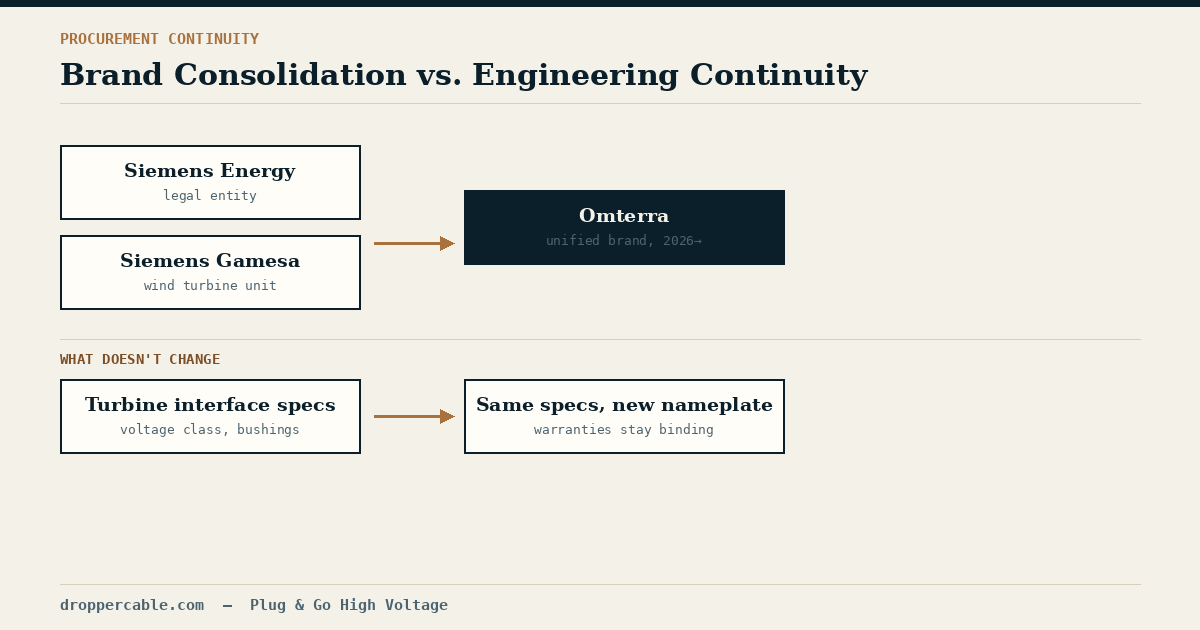
On July 22, 2026, Siemens Energy confirmed what industry watchers had expected since its 2020 spin-off from Siemens AG: the company is retiring the Siemens name. Siemens Energy and Siemens Gamesa Renewable Energy will consolidate under a single new brand, Omterra, with the rollout beginning later this year and continuing in stages across more than 90 countries. Siemens Gamesa, now fully owned by Siemens Energy since its 2023 delisting from the Spanish stock exchange, won’t survive as a separate product line or sub-brand — it folds into Omterra entirely.
Fleets like RWE’s Sofia offshore wind farm, where 100 Siemens Gamesa turbines were completed earlier this year, or projects such as Baltica 2 and Thor currently in the supply chain, are exactly the kind of installations this touches. For anyone running procurement or engineering on a project with Siemens Gamesa turbines already specified, ordered, or installed, the natural question is how much of this is a paperwork exercise versus something that touches actual hardware and contracts.
What Actually Changes
Siemens Energy has been explicit that the rebrand doesn’t alter strategic direction or existing relationships with customers and partners. In practical terms for procurement and engineering teams, that breaks down into a few concrete items:
Vendor and supplier registries will need updating as legal entity names shift to Omterra over the rollout period — a compliance and ERP task, not an engineering one. Existing contracts, warranties, and O&M agreements signed under the Siemens Energy or Siemens Gamesa name remain binding; a brand transition doesn’t void a warranty. And because the rebrand is explicitly described as a naming and identity change rather than a restructuring of the underlying business, turbine platforms already in production — the SG 14-222 DD and similar offshore models — should carry the same mechanical, thermal, and electrical baselines forward, just under a new nameplate over time.
Why This Matters More for Dropper Cables Than It Looks
A rebrand at the OEM level is exactly the kind of moment where supply chain assumptions quietly go stale. Procurement teams sourcing pre-terminated dropper cables and connection systems to match a specific turbine’s switchgear interface should treat this as a prompt to re-verify, not ignore, three things. First, that the connector interface specification for the turbine platform hasn’t changed alongside the name. Second, that any updated documentation from the OEM — drawings, interface control documents, datasheets — reflects the same electrical ratings as before. Third, that the supplier of record for dropper cable assemblies is still the correct match for the turbine’s current documentation set, whichever brand appears on the cover page.
This is worth taking seriously precisely because dropper cables sit at a mechanically demanding, safety-relevant interface — the connection between the nacelle and the tower-base switchgear, subject to constant yaw-induced torsion and tightly specified bend radii. As covered in our piece on what a dropper cable actually does, the industry has spent the last several years moving toward factory-preassembled, pretested connection systems specifically to remove variability from this step. A supplier transition or brand change is a reasonable trigger to double-check that a dropper cable assembly is still being sourced and tested to the same standard, not an occasion to skip that check because “it’s just a rebrand.”
The Procurement Takeaway
None of this should stall an active project. But it’s a fair moment for procurement leads to update approved-supplier documentation and confirm that turbine interface drawings referenced in purchase orders are current — our factory acceptance testing checklist is a reasonable template for what that reconfirmation should actually cover. It’s also worth reconfirming that any pre-terminated dropper cable or connector assembly on order is still being factory-tested before shipping, rather than assumed compatible on paper. Reynard builds preassembled turbine-to-base cable assemblies rated for 33kV and 66kV service, with that factory testing done before an assembly ever reaches a vessel. That’s a supplier detail worth reconfirming any time an OEM’s brand, entity name, or documentation set is in transition — regardless of which name ends up on the turbine nacelle.